- Studio
- Document AI
Document AI OCR processor
Document AI OCR processor
Use the Document AI OCR processor to extract text and structured content from PDF documents and images. The mistral-ocr-latest alias points to our latest OCR model.
Before you start
Key features
- Text extraction preserves the document structure and hierarchy.
- Table formatting supports null, markdown, and html values through the table_format parameter.
- null: Returns tables inline as Markdown within the extracted page.
- markdown: Returns tables separately as Markdown tables.
- html: Returns tables separately as HTML tables.
- Header and footer extraction uses the extract_header and extract_footer parameters. When you use them, the response includes header and footer content in the header and footer fields. By default, OCR treats headers and footers as part of the main content.
- Block extraction uses the include_blocks parameter. When enabled, each page contains a blocks array with paragraph-level bounding boxes, structural block labels, and extracted content in reading order.
- Confidence scores are available for extracted content at page, block, or word granularity through the confidence_scores_granularity parameter.
- Multilingual OCR performs strongly across more than 40 languages. For the full list, see supported languages.
- Document formats include:
- image_url: PNG, JPEG/JPG, AVIF, and other image formats.
- document_url: PDF, PPTX, DOCX, and other document formats.
- For more supported formats, see the FAQ.
For endpoint details, see the OCR API reference.
Table formatting as well as header and footer extraction is only available for OCR 2512 or newer. Block extraction via include_blocks is only available for OCR 4 or newer.
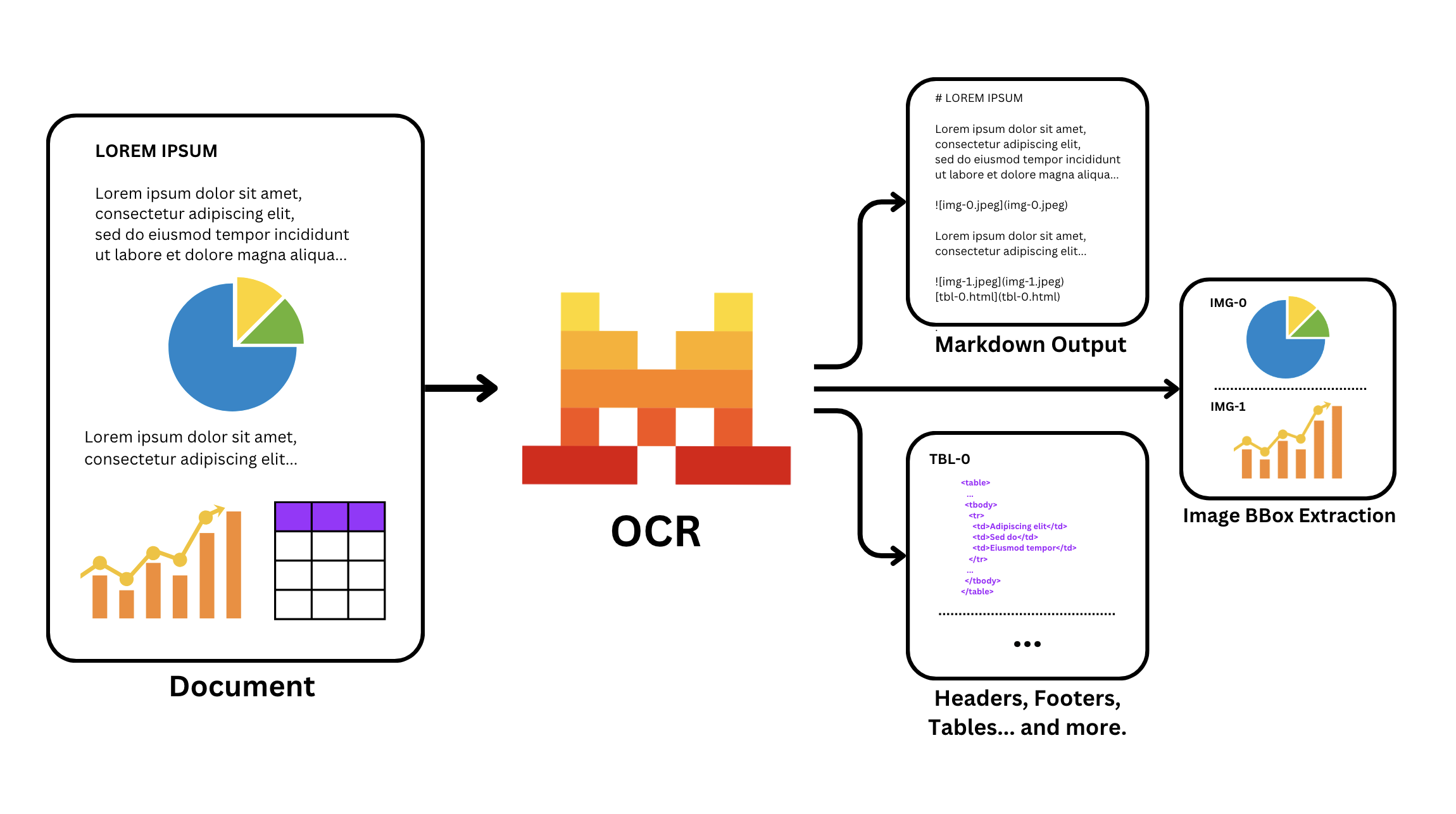
The OCR processor returns extracted text, image bounding boxes, and document-structure metadata.
OCR with images and PDFs
Process your documents
Use OCR with PDFs and images.
PDFs
For PDFs, pass a publicly available URL, pass a Base64-encoded PDF, or upload a PDF file.
Be sure the URL is public and accessible by our API.
# Not available in the V1 SDK (mistralai 1.x).
# This feature requires the V2 SDK: pip install "mistralai>=2", then use the V2 tab.
# Migration guide: https://docs.mistral.ai/resources/migration-guides
{
"pages": [
{
"index": 0,
"markdown": "# Leveraging Unlabeled Data to Predict Out-of-Distribution Performance\n\nSaurabh Garg\nCarnegie Mellon University\nsgarg2@andrew.cmu.edu\n&Sivaraman Balakrishnan\nCarnegie Mellon University\nsbalakri@andrew.cmu.edu\n&Zachary C. Lipton\nCarnegie Mellon University\nzlipton@andrew.cmu.edu\n&Behnam Neyshabur\nGoogle Research, Blueshift team\nneyshabur@google.com\n&Hanie Sedghi\nGoogle Research, Brain team\nhsedghi@google.com\n\n###### Abstract\n\nReal-world machine learning deployments are characterized by mismatches between the source (training) and target (test) distributions that may cause performance drops. In this work, we investigate methods for predicting the target domain accuracy using only labeled source data and unlabeled target data. We propose Average Thresholded Confidence (ATC), a practical method that learns a threshold on the model’s confidence, predicting accuracy as the fraction of unlabeled examples for which model confidence exceeds that threshold. ATC outperforms previous methods across several model architectures, types of distribution shifts (e.g., due to synthetic corruptions, dataset reproduction, or novel subpopulations), and datasets (Wilds, ImageNet, Breeds, CIFAR, and MNIST). In our experiments, ATC estimates target performance $2$–$4\\times$ more accurately than prior methods. We also explore the theoretical foundations of the problem, proving that, in general, identifying the accuracy is just as hard as identifying the optimal predictor and thus, the efficacy of any method rests upon (perhaps unstated) assumptions on the nature of the shift. Finally, analyzing our method on some toy distributions, we provide insights concerning when it works.\n\n## 1 Introduction\n\nMachine learning models deployed in the real world typically encounter examples from previously unseen distributions. While the IID assumption enables us to evaluate models using held-out data from the source distribution (from which training data is sampled), this estimate is no longer valid in presence of a distribution shift. Moreover, under such shifts, model accuracy tends to degrade *(Szegedy et al., 2014; Recht et al., 2019; Koh et al., 2021)*. Commonly, the only data available to the practitioner are a labeled training set (source) and unlabeled deployment-time data which makes the problem more difficult. In this setting, detecting shifts in the distribution of covariates is known to be possible (but difficult) in theory *(Ramdas et al., 2015)*, and in practice *(Rabanser et al., 2018)*. However, producing an optimal predictor using only labeled source and unlabeled target data is well-known to be impossible absent further assumptions *(Ben-David et al., 2010; Lipton et al., 2018)*.\n\nTwo vital questions that remain are: (i) the precise conditions under which we can estimate a classifier’s target-domain accuracy; and (ii) which methods are most practically useful. To begin, the straightforward way to assess the performance of a model under distribution shift would be to collect labeled (target domain) examples and then to evaluate the model on that data. However, collecting fresh labeled data from the target distribution is prohibitively expensive and time-consuming, especially if the target distribution is non-stationary. Hence, instead of using labeled data, we aim to use unlabeled data from the target distribution, that is comparatively abundant, to predict model performance. Note that in this work, our focus is not to improve performance on the target but, rather, to estimate the accuracy on the target for a given classifier.",
"images": [],
"tables": [],
"hyperlinks": [
"mailto:sgarg2%40andrew.cmu.edu",
"mailto:sbalakri%40andrew.cmu.edu",
"mailto:zlipton%40andrew.cmu.edu",
"mailto:neyshabur%40google.com",
"mailto:hsedghi%40google.com",
"https://github.com/saurabhgarg1996/ATC_code"
],
"header": null,
"footer": null,
"dimensions": {
"dpi": 200,
"height": 2200,
"width": 1700
}
},
{
"index": 1,
"markdown": "Published as a conference paper at ICLR 2022\n\n\nFigure 1: Illustration of our proposed method ATC. Left: using source domain validation data, we identify a threshold on a score (e.g. negative entropy) computed on model confidence such that fraction of examples above the threshold matches the validation set accuracy. ATC estimates accuracy on unlabeled target data as the fraction of examples with the score above the threshold. Interestingly, this threshold yields accurate estimates on a wide set of target distributions resulting from natural and synthetic shifts. Right: Efficacy of ATC over previously proposed approaches on our testbed with a post-hoc calibrated model. To obtain errors on the same scale, we rescale all errors with Average Confidence (AC) error. Lower estimation error is better. See Table 1 for exact numbers and comparison on various types of distribution shift. See Sec. 5 for details on our testbed.\n\n\n\nRecently, numerous methods have been proposed for this purpose (Deng & Zheng, 2021; Chen et al., 2021b; Jiang et al., 2021; Deng et al., 2021; Guillory et al., 2021). These methods either require calibration on the target domain to yield consistent estimates (Jiang et al., 2021; Guillory et al., 2021) or additional labeled data from several target domains to learn a linear regression function on a distributional distance that then predicts model performance (Deng et al., 2021; Deng & Zheng, 2021; Guillory et al., 2021). However, methods that require calibration on the target domain typically yield poor estimates since deep models trained and calibrated on source data are not, in general, calibrated on a (previously unseen) target domain (Ovadia et al., 2019). Besides, methods that leverage labeled data from target domains rely on the fact that unseen target domains exhibit strong linear correlation with seen target domains on the underlying distance measure and, hence, can be rendered ineffective when such target domains with labeled data are unavailable (in Sec. 5.1 we demonstrate such a failure on a real-world distribution shift problem). Therefore, throughout the paper, we assume access to labeled source data and only unlabeled data from target domain(s).\n\nIn this work, we first show that absent assumptions on the source classifier or the nature of the shift, no method of estimating accuracy will work generally (even in non-contrived settings). To estimate accuracy on target domain perfectly, we highlight that even given perfect knowledge of the labeled source distribution (i.e., $p_{s}(x,y)$ ) and unlabeled target distribution (i.e., $p_{t}(x)$ ), we need restrictions on the nature of the shift such that we can uniquely identify the target conditional $p_{t}(y|x)$ . Thus, in general, identifying the accuracy of the classifier is as hard as identifying the optimal predictor.\n\nSecond, motivated by the superiority of methods that use maximum softmax probability (or logit) of a model for Out-Of-Distribution (OOD) detection (Hendrycks & Gimpel, 2016; Hendrycks et al., 2019), we propose a simple method that leverages softmax probability to predict model performance. Our method, Average Thresholded Confidence (ATC), learns a threshold on a score (e.g., maximum confidence or negative entropy) of model confidence on validation source data and predicts target domain accuracy as the fraction of unlabeled target points that receive a score above that threshold. ATC selects a threshold on validation source data such that the fraction of source examples that receive the score above the threshold match the accuracy of those examples. Our primary contribution in ATC is the proposal of obtaining the threshold and observing its efficacy on (practical) accuracy estimation. Importantly, our work takes a step forward in positively answering the question raised in Deng & Zheng (2021); Deng et al. (2021) about a practical strategy to select a threshold that enables accuracy prediction with thresholded model confidence.",
"images": [
{
"id": "img-0.jpeg",
"top_left_x": 294,
"top_left_y": 222,
"bottom_right_x": 943,
"bottom_right_y": 635,
"image_base64": "data:image/jpeg;base64,...",
"image_annotation": null
}
],
"tables": [],
"hyperlinks": [],
"header": null,
"footer": null,
"dimensions": {
"dpi": 200,
"height": 2200,
"width": 1700
}
},
{
"index": 27,
"markdown": "Published as a conference paper at ICLR 2022\n\n[tbl-3.html](tbl-3.html)\n\nTable 3: Mean Absolute estimation Error (MAE) results for different datasets in our setup grouped by the nature of shift. 'Same' refers to same subpopulation shifts and 'Novel' refers novel subpopulation shifts. We include details about the target sets considered in each shift in Table 2. Post T denotes use of TS calibration on source. For language datasets, we use DistilBERT-base-uncased, for vision dataset we report results with DenseNet model with the exception of MNIST where we use FCN. Across all datasets, we observe that ATC achieves superior performance (lower MAE is better). For GDE post T and pre T estimates match since TS doesn't alter the argmax prediction. Results reported by aggregating MAE numbers over 4 different seeds. Values in parenthesis (i.e., $(\\cdot)$ ) denote standard deviation values.",
"images": [],
"tables": [
{
"id": "tbl-3.html",
"content": "<table><tr><td rowspan=\"2\">Dataset</td><td rowspan=\"2\">Shift</td><td colspan=\"2\">IM</td><td colspan=\"2\">AC</td><td colspan=\"2\">DOC</td><td>GDE</td><td colspan=\"2\">ATC-MC (Ours)</td><td colspan=\"2\">ATC-NE (Ours)</td></tr><tr><td>Pre T</td><td>Post T</td><td>Pre T</td><td>Post T</td><td>Pre T</td><td>Post T</td><td>Post T</td><td>Pre T</td><td>Post T</td><td>Pre T</td><td>Post T</td></tr><tr><td rowspan=\"4\">CIFAR10</td><td rowspan=\"2\">Natural</td><td>6.60</td><td>5.74</td><td>9.88</td><td>6.89</td><td>7.25</td><td>6.07</td><td>4.77</td><td>3.21</td><td>3.02</td><td>2.99</td><td>2.85</td></tr><tr><td>(0.35)</td><td>(0.30)</td><td>(0.16)</td><td>(0.13)</td><td>(0.15)</td><td>(0.16)</td><td>(0.13)</td><td>(0.49)</td><td>(0.40)</td><td>(0.37)</td><td>(0.29)</td></tr><tr><td rowspan=\"2\">Synthetic</td><td>12.33</td><td>10.20</td><td>16.50</td><td>11.91</td><td>13.87</td><td>11.08</td><td>6.55</td><td>4.65</td><td>4.25</td><td>4.21</td><td>3.87</td></tr><tr><td>(0.51)</td><td>(0.48)</td><td>(0.26)</td><td>(0.17)</td><td>(0.18)</td><td>(0.17)</td><td>(0.35)</td><td>(0.55)</td><td>(0.55)</td><td>(0.55)</td><td>(0.75)</td></tr><tr><td rowspan=\"2\">CIFAR100</td><td rowspan=\"2\">Synthetic</td><td>13.69</td><td>11.51</td><td>23.61</td><td>13.10</td><td>14.60</td><td>10.14</td><td>9.85</td><td>5.50</td><td>4.75</td><td>4.72</td><td>4.94</td></tr><tr><td>(0.55)</td><td>(0.41)</td><td>(1.16)</td><td>(0.80)</td><td>(0.77)</td><td>(0.64)</td><td>(0.57)</td><td>(0.70)</td><td>(0.73)</td><td>(0.74)</td><td>(0.74)</td></tr><tr><td rowspan=\"4\">ImageNet200</td><td rowspan=\"2\">Natural</td><td>12.37</td><td>8.19</td><td>22.07</td><td>8.61</td><td>15.17</td><td>7.81</td><td>5.13</td><td>4.37</td><td>2.04</td><td>3.79</td><td>1.45</td></tr><tr><td>(0.25)</td><td>(0.33)</td><td>(0.08)</td><td>(0.25)</td><td>(0.11)</td><td>(0.29)</td><td>(0.08)</td><td>(0.39)</td><td>(0.24)</td><td>(0.30)</td><td>(0.27)</td></tr><tr><td rowspan=\"2\">Synthetic</td><td>19.86</td><td>12.94</td><td>32.44</td><td>13.35</td><td>25.02</td><td>12.38</td><td>5.41</td><td>5.93</td><td>3.09</td><td>5.00</td><td>2.68</td></tr><tr><td>(1.38)</td><td>(1.81)</td><td>(1.00)</td><td>(1.30)</td><td>(1.10)</td><td>(1.38)</td><td>(0.89)</td><td>(1.38)</td><td>(0.87)</td><td>(1.28)</td><td>(0.45)</td></tr><tr><td rowspan=\"4\">ImageNet</td><td rowspan=\"2\">Natural</td><td>7.77</td><td>6.50</td><td>18.13</td><td>6.02</td><td>8.13</td><td>5.76</td><td>6.23</td><td>3.88</td><td>2.17</td><td>2.06</td><td>0.80</td></tr><tr><td>(0.27)</td><td>(0.33)</td><td>(0.23)</td><td>(0.34)</td><td>(0.27)</td><td>(0.37)</td><td>(0.41)</td><td>(0.53)</td><td>(0.62)</td><td>(0.54)</td><td>(0.44)</td></tr><tr><td rowspan=\"2\">Synthetic</td><td>13.39</td><td>10.12</td><td>24.62</td><td>8.51</td><td>13.55</td><td>7.90</td><td>6.32</td><td>3.34</td><td>2.53</td><td>2.61</td><td>4.89</td></tr><tr><td>(0.53)</td><td>(0.63)</td><td>(0.64)</td><td>(0.71)</td><td>(0.61)</td><td>(0.72)</td><td>(0.33)</td><td>(0.53)</td><td>(0.36)</td><td>(0.33)</td><td>(0.83)</td></tr><tr><td rowspan=\"2\">FMoW-WILDS</td><td rowspan=\"2\">Natural</td><td>5.53</td><td>4.31</td><td>33.53</td><td>12.84</td><td>5.94</td><td>4.45</td><td>5.74</td><td>3.06</td><td>2.70</td><td>3.02</td><td>2.72</td></tr><tr><td>(0.33)</td><td>(0.63)</td><td>(0.13)</td><td>(12.06)</td><td>(0.36)</td><td>(0.77)</td><td>(0.55)</td><td>(0.36)</td><td>(0.54)</td><td>(0.35)</td><td>(0.44)</td></tr><tr><td rowspan=\"2\">RxRx1-WILDS</td><td rowspan=\"2\">Natural</td><td>5.80</td><td>5.72</td><td>7.90</td><td>4.84</td><td>5.98</td><td>5.98</td><td>6.03</td><td>4.66</td><td>4.56</td><td>4.41</td><td>4.47</td></tr><tr><td>(0.17)</td><td>(0.15)</td><td>(0.24)</td><td>(0.09)</td><td>(0.15)</td><td>(0.13)</td><td>(0.08)</td><td>(0.38)</td><td>(0.38)</td><td>(0.31)</td><td>(0.26)</td></tr><tr><td rowspan=\"2\">Amazon-WILDS</td><td rowspan=\"2\">Natural</td><td>2.40</td><td>2.29</td><td>8.01</td><td>2.38</td><td>2.40</td><td>2.28</td><td>17.87</td><td>1.65</td><td>1.62</td><td>1.60</td><td>1.59</td></tr><tr><td>(0.08)</td><td>(0.09)</td><td>(0.53)</td><td>(0.17)</td><td>(0.09)</td><td>(0.09)</td><td>(0.18)</td><td>(0.06)</td><td>(0.05)</td><td>(0.14)</td><td>(0.15)</td></tr><tr><td rowspan=\"2\">CivilCom.-WILDS</td><td rowspan=\"2\">Natural</td><td>12.64</td><td>10.80</td><td>16.76</td><td>11.03</td><td>13.31</td><td>10.99</td><td>16.65</td><td></td><td>7.14</td><td></td><td></td></tr><tr><td>(0.52)</td><td>(0.48)</td><td>(0.53)</td><td>(0.49)</td><td>(0.52)</td><td>(0.49)</td><td>(0.25)</td><td></td><td>(0.41)</td><td></td><td></td></tr><tr><td rowspan=\"2\">MNIST</td><td rowspan=\"2\">Natural</td><td>18.48</td><td>15.99</td><td>21.17</td><td>14.81</td><td>20.19</td><td>14.56</td><td>24.42</td><td>5.02</td><td>2.40</td><td>3.14</td><td>3.50</td></tr><tr><td>(0.45)</td><td>(1.53)</td><td>(0.24)</td><td>(3.89)</td><td>(0.23)</td><td>(3.47)</td><td>(0.41)</td><td>(0.44)</td><td>(1.83)</td><td>(0.49)</td><td>(0.17)</td></tr><tr><td rowspan=\"4\">ENTITY-13</td><td rowspan=\"2\">Same</td><td>16.23</td><td>11.14</td><td>24.97</td><td>10.88</td><td>19.08</td><td>10.47</td><td>10.71</td><td>5.39</td><td>3.88</td><td>4.58</td><td>4.19</td></tr><tr><td>(0.77)</td><td>(0.65)</td><td>(0.70)</td><td>(0.77)</td><td>(0.65)</td><td>(0.72)</td><td>(0.74)</td><td>(0.92)</td><td>(0.61)</td><td>(0.85)</td><td>(0.16)</td></tr><tr><td rowspan=\"2\">Novel</td><td>28.53</td><td>22.02</td><td>38.33</td><td>21.64</td><td>32.43</td><td>21.22</td><td>20.61</td><td>13.58</td><td>10.28</td><td>12.25</td><td>6.63</td></tr><tr><td>(0.82)</td><td>(0.68)</td><td>(0.75)</td><td>(0.86)</td><td>(0.69)</td><td>(0.80)</td><td>(0.60)</td><td>(1.15)</td><td>(1.34)</td><td>(1.21)</td><td>(0.93)</td></tr><tr><td rowspan=\"4\">ENTITY-30</td><td rowspan=\"2\">Same</td><td>18.59</td><td>14.46</td><td>28.82</td><td>14.30</td><td>21.63</td><td>13.46</td><td>12.92</td><td>9.12</td><td>7.75</td><td>8.15</td><td>7.64</td></tr><tr><td>(0.51)</td><td>(0.52)</td><td>(0.43)</td><td>(0.71)</td><td>(0.37)</td><td>(0.59)</td><td>(0.14)</td><td>(0.62)</td><td>(0.72)</td><td>(0.68)</td><td>(0.88)</td></tr><tr><td rowspan=\"2\">Novel</td><td>32.34</td><td>26.85</td><td>44.02</td><td>26.27</td><td>36.82</td><td>25.42</td><td>23.16</td><td>17.75</td><td>14.30</td><td>15.60</td><td>10.57</td></tr><tr><td>(0.60)</td><td>(0.58)</td><td>(0.56)</td><td>(0.79)</td><td>(0.47)</td><td>(0.68)</td><td>(0.12)</td><td>(0.76)</td><td>(0.85)</td><td>(0.86)</td><td>(0.86)</td></tr><tr><td rowspan=\"4\">NONLIVING-26</td><td rowspan=\"2\">Same</td><td>18.66</td><td>17.17</td><td>26.39</td><td>16.14</td><td>19.86</td><td>15.58</td><td>16.63</td><td>10.87</td><td>10.24</td><td>10.07</td><td>10.26</td></tr><tr><td>(0.76)</td><td>(0.74)</td><td>(0.82)</td><td>(0.81)</td><td>(0.67)</td><td>(0.76)</td><td>(0.45)</td><td>(0.98)</td><td>(0.83)</td><td>(0.92)</td><td>(1.18)</td></tr><tr><td rowspan=\"2\">Novel</td><td>33.43</td><td>31.53</td><td>41.66</td><td>29.87</td><td>35.13</td><td>29.31</td><td>29.56</td><td>21.70</td><td>20.12</td><td>19.08</td><td>18.26</td></tr><tr><td>(0.67)</td><td>(0.65)</td><td>(0.67)</td><td>(0.71)</td><td>(0.54)</td><td>(0.64)</td><td>(0.21)</td><td>(0.86)</td><td>(0.75)</td><td>(0.82)</td><td>(1.12)</td></tr><tr><td rowspan=\"4\">LIVING-17</td><td rowspan=\"2\">Same</td><td>12.63</td><td>11.05</td><td>18.32</td><td>10.46</td><td>14.43</td><td>10.14</td><td>9.87</td><td>4.57</td><td>3.95</td><td>3.81</td><td>4.21</td></tr><tr><td>(1.25)</td><td>(1.20)</td><td>(1.01)</td><td>(1.12)</td><td>(1.11)</td><td>(1.16)</td><td>(0.61)</td><td>(0.71)</td><td>(0.48)</td><td>(0.22)</td><td>(0.53)</td></tr><tr><td rowspan=\"2\">Novel</td><td>29.03</td><td>26.96</td><td>35.67</td><td>26.11</td><td>31.73</td><td>25.73</td><td>23.53</td><td>16.15</td><td>14.49</td><td>12.97</td><td>11.39</td></tr><tr><td>(1.44)</td><td>(1.38)</td><td>(1.09)</td><td>(1.27)</td><td>(1.19)</td><td>(1.35)</td><td>(0.52)</td><td>(1.36)</td><td>(1.46)</td><td>(1.52)</td><td>(1.72)</td></tr></table>",
"format": "html"
}
],
"hyperlinks": [],
"header": null,
"footer": null,
"dimensions": {
"dpi": 200,
"height": 2200,
"width": 1700
}
},
{
"index": 28,
"markdown": "Published as a conference paper at ICLR 2022\n\n[tbl-4.html](tbl-4.html)\n\nTable 4: Mean Absolute estimation Error (MAE) results for different datasets in our setup grouped by the nature of shift for ResNet model. 'Same' refers to same subpopulation shifts and 'Novel' refers novel subpopulation shifts. We include details about the target sets considered in each shift in Table 2. Post T denotes use of TS calibration on source. Across all datasets, we observe that ATC achieves superior performance (lower MAE is better). For GDE post T and pre T estimates match since TS doesn't alter the argmax prediction. Results reported by aggregating MAE numbers over 4 different seeds. Values in parenthesis (i.e., $(\\cdot)$ ) denote standard deviation values.",
"images": [],
"tables": [
{
"id": "tbl-4.html",
"content": "<table><tr><td rowspan=\"2\">Dataset</td><td rowspan=\"2\">Shift</td><td colspan=\"2\">IM</td><td colspan=\"2\">AC</td><td colspan=\"2\">DOC</td><td>GDE</td><td colspan=\"2\">ATC-MC (Ours)</td><td colspan=\"2\">ATC-NE (Ours)</td></tr><tr><td>Pre T</td><td>Post T</td><td>Pre T</td><td>Post T</td><td>Pre T</td><td>Post T</td><td>Post T</td><td>Pre T</td><td>Post T</td><td>Pre T</td><td>Post T</td></tr><tr><td rowspan=\"4\">CIFAR10</td><td rowspan=\"2\">Natural</td><td>7.14</td><td>6.20</td><td>10.25</td><td>7.06</td><td>7.68</td><td>6.35</td><td>5.74</td><td>4.02</td><td>3.85</td><td>3.76</td><td>3.38</td></tr><tr><td>(0.14)</td><td>(0.11)</td><td>(0.31)</td><td>(0.33)</td><td>(0.28)</td><td>(0.27)</td><td>(0.25)</td><td>(0.38)</td><td>(0.30)</td><td>(0.33)</td><td>(0.32)</td></tr><tr><td rowspan=\"2\">Synthetic</td><td>12.62</td><td>10.75</td><td>16.50</td><td>11.91</td><td>13.93</td><td>11.20</td><td>7.97</td><td>5.66</td><td>5.03</td><td>4.87</td><td>3.63</td></tr><tr><td>(0.76)</td><td>(0.71)</td><td>(0.28)</td><td>(0.24)</td><td>(0.29)</td><td>(0.28)</td><td>(0.13)</td><td>(0.64)</td><td>(0.71)</td><td>(0.71)</td><td>(0.62)</td></tr><tr><td rowspan=\"2\">CIFAR100</td><td rowspan=\"2\">Synthetic</td><td>12.77</td><td>12.34</td><td>16.89</td><td>12.73</td><td>11.18</td><td>9.63</td><td>12.00</td><td>5.61</td><td>5.55</td><td>5.65</td><td>5.76</td></tr><tr><td>(0.43)</td><td>(0.68)</td><td>(0.20)</td><td>(2.59)</td><td>(0.35)</td><td>(1.25)</td><td>(0.48)</td><td>(0.51)</td><td>(0.55)</td><td>(0.35)</td><td>(0.27)</td></tr><tr><td rowspan=\"4\">ImageNet200</td><td rowspan=\"2\">Natural</td><td>12.63</td><td>7.99</td><td>23.08</td><td>7.22</td><td>15.40</td><td>6.33</td><td>5.00</td><td>4.60</td><td>1.80</td><td>4.06</td><td>1.38</td></tr><tr><td>(0.59)</td><td>(0.47)</td><td>(0.31)</td><td>(0.22)</td><td>(0.42)</td><td>(0.24)</td><td>(0.36)</td><td>(0.63)</td><td>(0.17)</td><td>(0.69)</td><td>(0.29)</td></tr><tr><td rowspan=\"2\">Synthetic</td><td>20.17</td><td>11.74</td><td>33.69</td><td>9.51</td><td>25.49</td><td>8.61</td><td>4.19</td><td>5.37</td><td>2.78</td><td>4.53</td><td>3.58</td></tr><tr><td>(0.74)</td><td>(0.80)</td><td>(0.73)</td><td>(0.51)</td><td>(0.66)</td><td>(0.50)</td><td>(0.14)</td><td>(0.88)</td><td>(0.23)</td><td>(0.79)</td><td>(0.33)</td></tr><tr><td rowspan=\"4\">ImageNet</td><td rowspan=\"2\">Natural</td><td>8.09</td><td>6.42</td><td>21.66</td><td>5.91</td><td>8.53</td><td>5.21</td><td>5.90</td><td>3.93</td><td>1.89</td><td>2.45</td><td>0.73</td></tr><tr><td>(0.25)</td><td>(0.28)</td><td>(0.38)</td><td>(0.22)</td><td>(0.26)</td><td>(0.25)</td><td>(0.44)</td><td>(0.26)</td><td>(0.21)</td><td>(0.16)</td><td>(0.10)</td></tr><tr><td rowspan=\"2\">Synthetic</td><td>13.93</td><td>9.90</td><td>28.05</td><td>7.56</td><td>13.82</td><td>6.19</td><td>6.70</td><td>3.33</td><td>2.55</td><td>2.12</td><td>5.06</td></tr><tr><td>(0.14)</td><td>(0.23)</td><td>(0.39)</td><td>(0.13)</td><td>(0.31)</td><td>(0.07)</td><td>(0.52)</td><td>(0.25)</td><td>(0.25)</td><td>(0.31)</td><td>(0.27)</td></tr><tr><td rowspan=\"2\">FMoW-WILDS</td><td rowspan=\"2\">Natural</td><td>5.15</td><td>3.55</td><td>34.64</td><td>5.03</td><td>5.58</td><td>3.46</td><td>5.08</td><td>2.59</td><td>2.33</td><td>2.52</td><td>2.22</td></tr><tr><td>(0.19)</td><td>(0.41)</td><td>(0.22)</td><td>(0.29)</td><td>(0.17)</td><td>(0.37)</td><td>(0.46)</td><td>(0.32)</td><td>(0.28)</td><td>(0.25)</td><td>(0.30)</td></tr><tr><td rowspan=\"2\">RxRx1-WILDS</td><td rowspan=\"2\">Natural</td><td>6.17</td><td>6.11</td><td>21.05</td><td>5.21</td><td>6.54</td><td>6.27</td><td>6.82</td><td>5.30</td><td>5.20</td><td>5.19</td><td>5.63</td></tr><tr><td>(0.20)</td><td>(0.24)</td><td>(0.31)</td><td>(0.18)</td><td>(0.21)</td><td>(0.20)</td><td>(0.31)</td><td>(0.30)</td><td>(0.44)</td><td>(0.43)</td><td>(0.55)</td></tr><tr><td rowspan=\"4\">ENTITY-13</td><td rowspan=\"2\">Same</td><td>18.32</td><td>14.38</td><td>27.79</td><td>13.56</td><td>20.50</td><td>13.22</td><td>16.09</td><td>9.35</td><td>7.50</td><td>7.80</td><td>6.94</td></tr><tr><td>(0.29)</td><td>(0.53)</td><td>(1.18)</td><td>(0.58)</td><td>(0.47)</td><td>(0.58)</td><td>(0.84)</td><td>(0.79)</td><td>(0.65)</td><td>(0.62)</td><td>(0.71)</td></tr><tr><td rowspan=\"2\">Novel</td><td>28.82</td><td>24.03</td><td>38.97</td><td>22.96</td><td>31.66</td><td>22.61</td><td>25.26</td><td>17.11</td><td>13.96</td><td>14.75</td><td>9.94</td></tr><tr><td>(0.30)</td><td>(0.55)</td><td>(1.32)</td><td>(0.59)</td><td>(0.54)</td><td>(0.58)</td><td>(1.08)</td><td>(0.84)</td><td>(0.93)</td><td>(0.64)</td><td>(0.78)</td></tr><tr><td rowspan=\"4\">ENTITY-30</td><td rowspan=\"2\">Same</td><td>16.91</td><td>14.61</td><td>26.84</td><td>14.37</td><td>18.60</td><td>13.11</td><td>13.74</td><td>8.54</td><td>7.94</td><td>7.77</td><td>8.04</td></tr><tr><td>(1.33)</td><td>(1.11)</td><td>(2.15)</td><td>(1.34)</td><td>(1.69)</td><td>(1.30)</td><td>(1.07)</td><td>(1.47)</td><td>(1.38)</td><td>(1.44)</td><td>(1.51)</td></tr><tr><td rowspan=\"2\">Novel</td><td>28.66</td><td>25.83</td><td>39.21</td><td>25.03</td><td>30.95</td><td>23.73</td><td>23.15</td><td>15.57</td><td>13.24</td><td>12.44</td><td>11.05</td></tr><tr><td>(1.16)</td><td>(0.88)</td><td>(2.03)</td><td>(1.11)</td><td>(1.64)</td><td>(1.11)</td><td>(0.51)</td><td>(1.44)</td><td>(1.15)</td><td>(1.26)</td><td>(1.13)</td></tr><tr><td rowspan=\"4\">NONLIVING-26</td><td rowspan=\"2\">Same</td><td>17.43</td><td>15.95</td><td>27.70</td><td>15.40</td><td>18.06</td><td>14.58</td><td>16.99</td><td>10.79</td><td>10.13</td><td>10.05</td><td>10.29</td></tr><tr><td>(0.90)</td><td>(0.86)</td><td>(0.90)</td><td>(0.69)</td><td>(1.00)</td><td>(0.78)</td><td>(1.25)</td><td>(0.62)</td><td>(0.32)</td><td>(0.46)</td><td>(0.79)</td></tr><tr><td rowspan=\"2\">Novel</td><td>29.51</td><td>27.75</td><td>40.02</td><td>26.77</td><td>30.36</td><td>25.93</td><td>27.70</td><td>19.64</td><td>17.75</td><td>16.90</td><td>15.69</td></tr><tr><td>(0.86)</td><td>(0.82)</td><td>(0.76)</td><td>(0.82)</td><td>(0.95)</td><td>(0.80)</td><td>(1.42)</td><td>(0.68)</td><td>(0.53)</td><td>(0.60)</td><td>(0.83)</td></tr><tr><td rowspan=\"4\">LIVING-17</td><td rowspan=\"2\">Same</td><td>14.28</td><td>12.21</td><td>23.46</td><td>11.16</td><td>15.22</td><td>10.78</td><td>10.49</td><td>4.92</td><td>4.23</td><td>4.19</td><td>4.73</td></tr><tr><td>(0.96)</td><td>(0.93)</td><td>(1.16)</td><td>(0.90)</td><td>(0.96)</td><td>(0.99)</td><td>(0.97)</td><td>(0.57)</td><td>(0.42)</td><td>(0.35)</td><td>(0.24)</td></tr><tr><td rowspan=\"2\">Novel</td><td>28.91</td><td>26.35</td><td>38.62</td><td>24.91</td><td>30.32</td><td>24.52</td><td>22.49</td><td>15.42</td><td>13.02</td><td>12.29</td><td>10.34</td></tr><tr><td>(0.66)</td><td>(0.73)</td><td>(1.01)</td><td>(0.61)</td><td>(0.59)</td><td>(0.74)</td><td>(0.85)</td><td>(0.59)</td><td>(0.53)</td><td>(0.73)</td><td>(0.62)</td></tr></table>",
"format": "html"
}
],
"hyperlinks": [],
"header": null,
"footer": null,
"dimensions": {
"dpi": 200,
"height": 2200,
"width": 1700
}
}
],
"model": "mistral-ocr-2512",
"document_annotation": null,
"usage_info": {
"pages_processed": 29,
"doc_size_bytes": 3002783
}
}
The output is a JSON object that contains the extracted text, image bounding boxes, metadata, and other document-structure information.
{
  "pages": [ # The content of each page
    {
      "index": int, # The index of the corresponding page
      "markdown": str, # The main output and raw markdown content
      "images": list, # Image information when images are extracted
      "tables": list, # Table information when using `table_format=html` or `table_format=markdown`
      "hyperlinks": list, # Hyperlinks detected
      "header": str|null, # Header content when using `extract_header=True`
      "footer": str|null, # Footer content when using `extract_footer=True`
      "dimensions": dict, # The dimensions of the page
      "confidence_scores": dict|null, # Page confidence scores when `confidence_scores_granularity` is set (contains `word_confidence_scores` only for word granularity)
      "blocks": list|null # Paragraph-level bounding boxes with block labels when using `include_blocks=True`; each block includes `confidence_scores` only for block granularity
    }
  ],
  "model": str, # The model used for the OCR
  "document_annotation": dict|null, # Document annotation information when used, visit the Annotations documentation for more information
  "usage_info": dict # Usage information
}
When OCR extracts images and tables, the Markdown output uses placeholders such as:
- 
- [tbl-3.html](tbl-3.html)
Use the images and tables fields to map each placeholder to the extracted image or table.
Images
For images, pass an image URL or a Base64-encoded image.
You can perform OCR with any public available image as long as a direct url is available.
import os
from mistralai import Mistral

api_key = os.environ["MISTRAL_API_KEY"]

client = Mistral(api_key=api_key)

ocr_response = client.ocr.process(
    model="mistral-ocr-latest",
    document={
        "type": "image_url",
        "image_url": "https://raw.githubusercontent.com/mistralai/cookbook/refs/heads/main/mistral/ocr/receipt.png"
    },
    # table_format=None,
    include_image_base64=True
)
{
  "pages": [
    {
      "index": 0,
      "markdown": "PLACE FACE UP ON DASH\nCITY OF PALO ALTO\nNOT VALID FOR\nONSTREET PARKING\n\nExpiration Date/Time\n11:59 PM\nAUG 19, 2024\n\nPurchase Date/Time: 01:34pm Aug 19, 2024\nTotal Due: $15.00\nTotal Paid: $15.00\nTicket #: 00005883\nS/N #: 520117260957\nSetting: Permit Machines\nMach Name: Civic Center\n\n#****-1224, Visa\nDISPLAY FACE UP ON DASH\n\nPERMIT EXPIRES\nAT MIDNIGHT",
      "images": [],
      "dimensions": {
        "dpi": 200,
        "height": 3210,
        "width": 1806
      }
    }
  ],
  "model": "mistral-ocr-2505-completion",
  "document_annotation": null,
  "usage_info": {
    "pages_processed": 1,
    "doc_size_bytes": 3110191
  }
}
The output is a JSON object that contains the extracted text, image bounding boxes, metadata, and other document-structure information.
{
  "pages": [ # The content of each page
    {
      "index": int, # The index of the corresponding page
      "markdown": str, # The main output and raw markdown content
      "images": list, # Image information when images are extracted
      "tables": list, # Table information when using `table_format=html` or `table_format=markdown`
      "hyperlinks": list, # Hyperlinks detected
      "header": str|null, # Header content when using `extract_header=True`
      "footer": str|null, # Footer content when using `extract_footer=True`
      "dimensions": dict, # The dimensions of the page
      "confidence_scores": dict|null, # Page confidence scores when `confidence_scores_granularity` is set (contains `word_confidence_scores` only for word granularity)
      "blocks": list|null # Paragraph-level bounding boxes with block labels when using `include_blocks=True`; each block includes `confidence_scores` only for block granularity
    }
  ],
  "model": str, # The model used for the OCR
  "document_annotation": dict|null, # Document annotation information when used, visit the Annotations documentation for more information
  "usage_info": dict # Usage information
}
When OCR extracts images and tables, the Markdown output uses placeholders such as:
- 
- [tbl-3.html](tbl-3.html)
Use the images and tables fields to map each placeholder to the extracted image or table.
Block extraction
Extract structural blocks with bounding boxes
Set include_blocks=True to receive a blocks array on each page. Each block describes a single content region with its label (type), bounding box coordinates, and the extracted content. Blocks are returned in reading order.
Each block includes type, top_left_x, top_left_y, bottom_right_x, bottom_right_y, and content.
When confidence_scores_granularity is set to "block", each block also includes confidence_scores with:
- average_content_confidence_score: Average confidence score for the extracted block content.
- minimum_content_confidence_score: Lowest confidence score in the extracted block content.
- block_type_confidence_score: Confidence score for the detected block type.
Content confidence scores can be null for blocks without textual content, such as image blocks.
Available block types
Block type | Description |
|---|---|
| text | A paragraph of body text. |
| title | A document title or section heading. |
| list | A bulleted or numbered list. |
| table | A table region. When tables are extracted, includes a table_id referencing the corresponding entry in tables. |
| image | An image region. Includes an image_id referencing the corresponding entry in images. |
| equation | A math equation. |
| caption | A caption associated with a figure or table. |
| code | A code block. |
| references | A bibliography or references section. |
| aside_text | A sidebar, callout, or other marginal text block. |
| header | A page header. |
| footer | A page footer. |
| signature | A signature region. content holds the transcribed name when legible, otherwise an empty string. |
import os
from mistralai.client import Mistral

api_key = os.environ["MISTRAL_API_KEY"]

client = Mistral(api_key=api_key)

ocr_response = client.ocr.process(
    model="mistral-ocr-latest",
    document={
        "type": "document_url",
        "document_url": "https://arxiv.org/pdf/2201.04234"
    },
    include_blocks=True,
    confidence_scores_granularity="block"
)
{
"pages": [
{
"index": 0,
"markdown": "# Leveraging Unlabeled Data to Predict Out-of-Distribution Performance\n\n\n\nFigure 1: Illustration of our proposed method ATC.\n\nReal-world machine learning deployments are characterized by mismatches between the source (training) and target (test) distributions...",
"images": [
{
"id": "img-0.jpeg",
"top_left_x": 294,
"top_left_y": 222,
"bottom_right_x": 943,
"bottom_right_y": 635,
"image_base64": null,
"image_annotation": null
}
],
"tables": [],
"hyperlinks": [],
"header": null,
"footer": null,
"dimensions": {
"dpi": 200,
"height": 2200,
"width": 1700
},
"blocks": [
{
"type": "title",
"top_left_x": 240,
"top_left_y": 180,
"bottom_right_x": 1460,
"bottom_right_y": 260,
"content": "Leveraging Unlabeled Data to Predict Out-of-Distribution Performance",
"confidence_scores": {
"average_content_confidence_score": 0.9982,
"minimum_content_confidence_score": 0.9921,
"block_type_confidence_score": 0.9999
}
},
{
"type": "image",
"top_left_x": 294,
"top_left_y": 222,
"bottom_right_x": 943,
"bottom_right_y": 635,
"content": "",
"image_id": "img-0.jpeg",
"confidence_scores": {
"average_content_confidence_score": null,
"minimum_content_confidence_score": null,
"block_type_confidence_score": 0.9998
}
},
{
"type": "caption",
"top_left_x": 294,
"top_left_y": 640,
"bottom_right_x": 943,
"bottom_right_y": 690,
"content": "Figure 1: Illustration of our proposed method ATC.",
"confidence_scores": {
"average_content_confidence_score": 0.9965,
"minimum_content_confidence_score": 0.9874,
"block_type_confidence_score": 0.9997
}
},
{
"type": "text",
"top_left_x": 290,
"top_left_y": 720,
"bottom_right_x": 1410,
"bottom_right_y": 1100,
"content": "Real-world machine learning deployments are characterized by mismatches between the source (training) and target (test) distributions...",
"confidence_scores": {
"average_content_confidence_score": 0.9941,
"minimum_content_confidence_score": 0.9820,
"block_type_confidence_score": 0.9998
}
},
{
"type": "equation",
"top_left_x": 600,
"top_left_y": 1140,
"bottom_right_x": 1080,
"bottom_right_y": 1200,
"content": "$p_{s}(x, y) \\neq p_{t}(x, y)$"
},
{
"type": "list",
"top_left_x": 290,
"top_left_y": 1240,
"bottom_right_x": 1410,
"bottom_right_y": 1480,
"content": "- Prompts: Several benchmarks have default prompts...\n- Evaluation Metrics: The official metrics typically require exact match..."
},
{
"type": "footer",
"top_left_x": 290,
"top_left_y": 2100,
"bottom_right_x": 1410,
"bottom_right_y": 2150,
"content": "Published as a conference paper at ICLR 2022"
}
]
}
],
"model": "mistral-ocr-4-1",
"document_annotation": null,
"usage_info": {
"pages_processed": 1,
"doc_size_bytes": 102400
}
}
Block extraction is only available for OCR 4 or newer. Older models accept the parameter but return an empty array.
Confidence scores
Extract confidence scores
The OCR processor can return confidence scores for extracted content to help you assess recognition quality. Use the confidence_scores_granularity parameter to control the level of detail:
Value | Description |
|---|---|
| "page" | Returns a confidence_scores object on each page with aggregate statistics (average_page_confidence_score, minimum_page_confidence_score). |
| "block" | Returns everything from "page", plus confidence_scores on each block when include_blocks is set to true. |
| "word" | Returns everything from "page", plus a word_confidence_scores array with per-word confidence values on each page and each table entry. |
import os
from mistralai.client import Mistral

api_key = os.environ["MISTRAL_API_KEY"]

client = Mistral(api_key=api_key)

ocr_response = client.ocr.process(
    model="mistral-ocr-latest",
    document={
        "type": "document_url",
        "document_url": "https://arxiv.org/pdf/2201.04234"
    },
    confidence_scores_granularity="word"  # Use "block" with include_blocks=True
)
{
  "pages": [
    {
      "index": 0,
      "markdown": "# Mistral OCR\n\nExtracting text with confidence.",
      "images": [],
      "tables": [],
      "hyperlinks": [],
      "header": null,
      "footer": null,
      "dimensions": {
        "dpi": 200,
        "height": 2200,
        "width": 1700
      },
      "confidence_scores": {
        "average_page_confidence_score": 0.9946,
        "minimum_page_confidence_score": 0.9823,
        "word_confidence_scores": [
          { "text": "#", "confidence": 0.9999, "start_index": 0 },
          { "text": " Mistral", "confidence": 0.9998, "start_index": 1 },
          { "text": " OCR", "confidence": 0.9991, "start_index": 9 },
          { "text": "\n\n", "confidence": 0.9996, "start_index": 13 },
          { "text": "Extracting", "confidence": 0.9987, "start_index": 15 },
          { "text": " text", "confidence": 0.9823, "start_index": 25 },
          { "text": " with", "confidence": 0.9945, "start_index": 30 },
          { "text": " confidence.", "confidence": 0.9976, "start_index": 35 }
        ]
      }
    }
  ],
  "model": "mistral-ocr-4-1",
  "document_annotation": null,
  "usage_info": {
    "pages_processed": 1,
    "doc_size_bytes": 102400
  }
}
OCR at scale
For high-volume OCR workloads, use the Batch Inference service to process documents in parallel. For structured outputs, use Annotations.
Cookbooks
For more OCR examples, see these cookbooks:
FAQ
Yes. Uploaded document files must be 50 MB or less and contain 1,000 pages or fewer.
The Document AI OCR processor supports the following document and image formats:
Documents | Images |
|---|---|
| PDF (.pdf) | JPEG (.jpg, .jpeg) |
| Word Documents (.docx, .doc) | PNG (.png) |
| PowerPoint (.pptx, .ppt) | AVIF (.avif) |
| Excel (.xlsx, .csv) | TIFF (.tiff) |
| Text Files (.txt) | GIF (.gif) |
| EPUB (.epub) | HEIC/HEIF (.heic, .heif) |
| XML/DocBook (.xml) | BMP (.bmp) |
| RTF (.rtf) | WebP (.webp) |
| OpenDocument Text (.odt) | |
| BibTeX/BibLaTeX (.bib) | |
| FictionBook (.fb2) | |
| Jupyter Notebooks (.ipynb) | |
| JATS XML (.xml) | |
| LaTeX (.tex) | |
| OPML (.opml) | |
| Troff (.1, .man) |