Release notes
Follow shipped product updates across Vibe, Studio, Admin, models, and the API.
Latest updates
Agents SDK: write an agent once, run it anywhere
The Agents SDK lets you build agents in Python: define the model, instructions, and tools once, then run the same code in your process, on your own workers, or as managed agents operated by Mistral. Sessions on a worker are durable — state survives crashes, and a session can pause for a human approval and resume later. It takes the infrastructure work out of long-running, tool-using agents.
Learn moreShow less
What's new
The Agents SDK lets you build agents in Python: define the model, instructions, and tools once, then run the same code in your process, on your own workers, or as managed agents operated by Mistral. Sessions on a worker are durable — state survives crashes, and a session can pause for a human approval and resume later. It takes the infrastructure work out of long-running, tool-using agents.
Key capabilities
- One codebase, three run modes: run in-process while developing, serve a self-hosted worker with
agents serve, or deploy managed agents on Mistral infrastructure withagents deploy. - Durable sessions: session state survives worker crashes and resumes from the last completed step, and a session can pause for human-in-the-loop approvals.
- A composable harness: typed Python tools, code sandboxes, connectors and MCP servers, skills, permission gates, and custom hooks.
- Studio tracing on by default: agent turns, model calls, and tool calls appear in Studio traces.
Workflow builder: describe your automation in natural language
The workflow builder turns a natural-language description into a working workflow: Vibe writes it, tests it, and deploys it, and you can inspect and edit the generated code at every step. It opens workflow authoring to builders who don't write code and lets developers skip the scaffolding.
Learn moreShow less
What's new
The workflow builder turns a natural-language description into a working workflow: Vibe writes it, tests it, and deploys it, and you can inspect and edit the generated code at every step. It opens workflow authoring to builders who don't write code and lets developers skip the scaffolding.
Key capabilities
- Generate a workflow from a plain-language description of the process, then refine it in the same interface.
- Deploy to a managed deployment directly from the builder, from idea to production in one place.
- Inspect, fix, and improve the generated workflow code — no black box.
HTTP API connectors: connect any web API
Connectors now speak HTTP, not only MCP: register a web API by describing its operations, and agents and workflows can call it without anyone building and hosting an MCP server. This unlocks the many services that expose an HTTP API but have no MCP server, and stops MCP wrappers from hiding useful fields and operations.
Learn moreShow less
What's new
Connectors now speak HTTP, not only MCP: register a web API by describing its operations, and agents and workflows can call it without anyone building and hosting an MCP server. This unlocks the many services that expose an HTTP API but have no MCP server, and stops MCP wrappers from hiding useful fields and operations.
Key capabilities
- Register a web API as a connector with no MCP server: describe its operations once and reuse them everywhere.
- Use HTTP connectors programmatically in workflows and agentically in conversations and agents.
- The full operation surface stays visible: no wrapper hiding fields or endpoints.
Mistral Apps CLI: scaffold, develop, and deploy Studio apps
The new `mistral apps` commands scaffold an app from a capability registry, run it locally, and deploy it to Studio in one command. Building a Studio app no longer starts from an empty repository.
Learn moreShow less
What's new
The new mistral apps commands scaffold an app from a capability registry, run it locally, and deploy it to Studio in one command. Building a Studio app no longer starts from an empty repository.
Key capabilities
mistral apps initscaffolds an app from a public or private capability registry.mistral apps devruns the app locally for fast iteration, with an agent if you want one.mistral apps deployprovisions the app under Apps in Studio.- Apps are built from reusable capabilities, such as a database or a workflow worker, and
mistral apps capability addadds one to an existing app.
Offline evaluations with the Evaluation SDK
The Evaluation SDK and the workflow eval plugin run offline evaluations from your own code and store the results in Studio, where you browse runs, compare versions, and analyze records. Evaluations become a first-party Studio experience instead of scripts and spreadsheets.
Learn moreShow less
What's new
The Evaluation SDK and the workflow eval plugin run offline evaluations from your own code and store the results in Studio, where you browse runs, compare versions, and analyze records. Evaluations become a first-party Studio experience instead of scripts and spreadsheets.
Key capabilities
- Run evaluations from the
mistralai-evaluationsSDK or the workflow eval plugin, with the same projects and runs in Studio. - Browse evaluation projects, runs, and records; compare versions to catch regressions.
- Define goals that score each run.
Managed datasets for evaluations
Datasets in Studio are no longer tied to conversations: create one from CSV or JSONL files or from free-format records, and use it in your evaluations. Bring your own test data to evaluations without building pipelines.
Learn moreShow less
What's new
Datasets in Studio are no longer tied to conversations: create one from CSV or JSONL files or from free-format records, and use it in your evaluations. Bring your own test data to evaluations without building pipelines.
Key capabilities
- Create datasets from CSV or JSONL file uploads.
- Free-format record payloads: store the data your evaluations need, not only conversations.
- Dataset record counts at a glance in the dataset list.
Build datasets from production telemetry
Turn real production traffic into evaluation data: create a dataset record from a trace span in one click, curate a single trace, or build a whole dataset in bulk from telemetry — then review and annotate it before use.
Learn moreShow less
What's new
Turn real production traffic into evaluation data: create a dataset record from a trace span in one click, curate a single trace, or build a whole dataset in bulk from telemetry — then review and annotate it before use.
Key capabilities
- One-click dataset record from a span in the Trace Explorer.
- Bulk dataset creation from telemetry through an end-to-end flow.
- Review and annotate imported records before running evaluations.
Managed search index: a managed vector index for agents and workflows
The managed search index provisions a hosted vector index from a name, an embedding model, and an optional schema — no search backend to deploy or operate. Ingest and search company data through one API in the SDK, and give agents and workflows grounded answers without managing infrastructure.
Learn moreShow less
What's new
The managed search index provisions a hosted vector index from a name, an embedding model, and an optional schema — no search backend to deploy or operate. Ingest and search company data through one API in the SDK, and give agents and workflows grounded answers without managing infrastructure.
Key capabilities
- Provision a vector index with a declarative schema; Mistral operates the backing storage.
- Ingest and search through one API, exposed in the Mistral SDK.
- Plugs into the Search Toolkit: the managed index works with the same ingestion pipelines, QueryEngine, and retrievers as other backends.
Tracing for managed agents
Managed agents now send agent, model, and tool spans to Studio by default, with no extra package or configuration: open a session in Studio traces and follow each turn end to end. Spans are redacted on the worker before they leave, and you can turn one into a dataset record to evaluate it.
Learn moreShow less
What's new
Managed agents now send agent, model, and tool spans to Studio by default, with no extra package or configuration: open a session in Studio traces and follow each turn end to end. Spans are redacted on the worker before they leave, and you can turn one into a dataset record to evaluate it.
Key capabilities
- Agent, model, and tool spans for managed agents in Studio, on by default with zero setup.
- Default redaction masks common secrets and personal data before spans leave the worker; custom redaction policies are available.
- Add spans to a dataset from the Trace Explorer to evaluate real traffic.
Webhooks and triggers: react to events in your tools
Define webhooks and triggers from the Studio UI or the API to start workflows, spaces, and agents when something happens in your tools. Automations react to external events instead of waiting on a schedule.
Learn moreShow less
What's new
Define webhooks and triggers from the Studio UI or the API to start workflows, spaces, and agents when something happens in your tools. Automations react to external events instead of waiting on a schedule.
Key capabilities
- Define webhooks and triggers per workflow, space, or agent, from Studio or the API.
- Built-in ingestion for services like Notion and Lucca, with identity resolution, message normalization, and deduplication handled for you.
- Start a new workflow execution or agent session from an event.
Online evaluations: catch regressions on live traffic
Online evaluations score real sessions in production: point an evaluation at incoming traces and catch outcome regressions before customers report them. Test an evaluation on live traces in the UI before enabling it.
Learn moreShow less
What's new
Online evaluations score real sessions in production: point an evaluation at incoming traces and catch outcome regressions before customers report them. Test an evaluation on live traces in the UI before enabling it.
Key capabilities
- Run evaluations on live traffic in production.
- Test evaluations on live traces from the UI before enabling them.
- Catch regressions on real sessions, not only offline datasets.
Studio apps in Vibe Code Web
Studio apps now render inside Vibe Code Web: while you build a workflow with the workflow builder, its graph appears beside the conversation, so you watch the automation take shape as you describe it.
Learn moreShow less
What's new
Studio apps now render inside Vibe Code Web: while you build a workflow with the workflow builder, its graph appears beside the conversation, so you watch the automation take shape as you describe it.
Key capabilities
- Studio apps surface in Vibe Code Web through an MCP apps server.
- A live workflow graph next to the builder conversation.
- Build and interact with Studio primitives from Vibe without switching tools.
Secrets Manager — store and inject secrets in Studio
Secrets Manager is now available in Public Preview in Studio. Store, manage, and inject secrets — API keys, tokens, and credentials — directly into your managed deployments. Secrets are scoped to your workspace with role-based access control, versioned for safe rotation, and fully audited. No more hardcoding credentials in code or sharing them over chat.
Learn moreShow less
What's new
Secrets Manager is now available in Public Preview in Studio. Store, manage, and inject secrets — API keys, tokens, and credentials — directly into your managed deployments. Secrets are scoped to your workspace with role-based access control, versioned for safe rotation, and fully audited. No more hardcoding credentials in code or sharing them over chat.
Key capabilities
- Secrets Manager UI in Studio to create, organize, and manage secrets from your workspace
- Workspace-scoped access control with role-based access control (RBAC)
- Version history and rotation for safe credential updates
- Runtime secret injection into managed deployments via workload identity — no redeploy needed
- Enterprise audit logs for every secret access and change, with no plaintext values stored
Get started
Secrets Manager is available today in Studio. Open your workspace, create your first secret, and inject it into your managed deployments.
Secrets Manager documentationWorkflow Visualizer
Studio renders any Workflow as a read-only graph of its activities and execution paths, generated automatically from your code.
Learn moreShow less
What's new
Studio now renders any Workflow as a read-only graph of its activities and execution paths, generated automatically from your workflow code. AI-generated summaries describe each step, and the graph stays in sync as the code changes.
Key capabilities
- Automatic graph generation. Every workflow is rendered as a directed graph of its activities, branches, loops, and execution paths, built from the workflow code and kept in sync as the code changes.
- AI-generated summaries. Each node and the workflow as a whole get a generated summary, with redaction that strips credentials and sensitive literals from source code before anything is summarized.
- Available in Studio and Vibe. The graph renders on the workflow detail page in Studio and as an MCP App directly inside Vibe, with PNG export and labels translated to your browser locale.
Managed Deployments
Managed Deployments let you run Workflows without provisioning or operating your own worker infrastructure, so you can easily build and deploy AI automations.
Learn moreShow less
What's new
Managed Deployments let you run Workflows without provisioning or operating your own worker infrastructure, so you can easily build and deploy AI automations. Push your code, set up a deployment, and Mistral will run the workers on Mistral Cloud. During Public Preview, managed deployments require a paid plan (Pay-as-you-go or Enterprise) and are subject to a quota. See the Managed Deployments documentation for quota details.
Key capabilities
- Run workers without infrastructure. Deploy Workflows from any public or private GitHub repository onto Mistral Cloud, which handles building, scaling, and lifecycle management.
- Full lifecycle management. Create, update, stop, start, restart, redeploy, and delete deployments from AI Studio or the API.
- Service Account authentication. Workers authenticate via service accounts instead of workspace API keys. Existing API-key deployments migrate automatically on next restart.
- Hardened deployments. Create deployments with network egress blocked at build and runtime.
- Logs in the UI. View build and worker logs for your deployment directly in AI Studio.
A simpler Vibe experience
Chat and Work are merging into one Vibe experience, with fewer decisions and less navigation. Ask a question or start a task from the same place, without switching tabs.
Learn moreShow less
What's new
The phased rollout starts September 14, 2026, with Free, Pro, and Teams accounts migrating progressively. Enterprise migration starts October 1, 2026, with administrators choosing when to migrate within an approximately six-month window.
Key capabilities
- One conversation list: Find your Chat and Work conversations together after your account migrates.
- Fast or Think: Choose
Fastfor quick responses orThinkfor deeper reasoning in the message input, without leaving the conversation. - Skills: Use reusable instructions in place of Chat Agents. Deep Research is available as a Skill for source-backed research.
- Knowledge Base: Your Chat Memories migrate into a knowledge topic that you can review and manage.
- Temporary chat: Start a conversation without adding it to your history or Knowledge Base.
- Code Interpreter: On paid plans, ask Work to run Python for calculations, data analysis, and charts.
Get started
When your account has migrated, open Vibe and describe what you want to do. Follow the guide to start a task and review the result.
Get started with Vibe WorkSpreadsheets in Vibe Work
Work with Excel and CSV files in Vibe Work, from analyzing uploaded data to creating a workbook from a prompt. Review and edit the results in Canvas, then download an .xlsx file.
Learn moreShow less

What's new
Upload a workbook or describe a tracker or model to create. Ask Vibe Work to analyze, clean, or transform the data, then refine the result with follow-up prompts.
Key capabilities
- Analyze uploaded Excel and CSV data to summarize trends and identify inconsistencies.
- Ask Vibe Work to fix broken formulas, convert numbers stored as text, and standardize dates and formatting.
- Consolidate sheets, reshape tables, and join data from multiple files.
- Create trackers and models from a prompt, then iterate in the conversation.
- Review formulas and values in Canvas, edit cells, and download the workbook as an
.xlsxfile.
Get started
Available on paid plans on Serverless. Start with the spreadsheets guide. Before sharing business-critical work, verify formulas, calculations, and formatting in Excel.
Spreadsheets guideMini App Canvas
Mini App Canvas brings interactive apps and dashboards into Vibe Work. From a single prompt, create an app you can review, edit, and share without writing code or leaving the conversation.
Learn moreShow less

What's new
Turn your ideas and data into interactive dashboards, reports, and tools, rather than working only with static text. Build from a prompt or use data gathered through Connectors and Workflows, then refine the result in Canvas without starting over.
Key capabilities
- Multi-file React generation: Vibe Work creates components, data, and styles that work together as one interactive app.
- In-place editing: Refine the app through the conversation and see the changes in the same Canvas, without writing code.
- Data-backed apps: Generate dashboards, reports, and tools from data gathered through Connectors or Workflows, instead of starting from scratch.
- Flexible sharing: Share the Canvas alone or the whole conversation. Re-share after editing to update the shared link; changes are not synchronized continuously.
- Snapshot limits: Mini apps capture data at generation time, without live refresh or saved actions inside the app. Retrieve fresh data and regenerate the app to update it.
Get started
Describe the dashboard, report, or tool you want to create in Vibe Work. Follow the mini apps guide to refine and share it.
Create and share mini appsAgentic Knowledge Base
Vibe Work now builds and maintains a structured personal knowledge base for you, replacing flat, intrusive memories with pages you can browse, edit, and trust. It removes the context cold start of new sessions by retrieving relevant facts only when semantically necessary, so your assistant has the right background without force-inserting stored details into unrelated answers.
Learn moreShow less
What's new
Vibe Work now builds and maintains a structured personal knowledge base for you, replacing flat, intrusive memories with pages you can browse, edit, and trust. It removes the context cold start of new sessions by retrieving relevant facts only when semantically necessary, so your assistant has the right background without force-inserting stored details into unrelated answers.
Key capabilities
- File-based knowledge topics stored on browsable, editable pages instead of an opaque memory store, giving you full transparency and control over what the assistant remembers.
- Relevance-first recall that retrieves knowledge only when semantically relevant to your query, preventing the assistant from surfacing unrelated facts.
- Source attribution for recalled facts surfaced directly in the chain of thought and assistant message, so you always know where an answer came from.
- Guided onboarding interview that bootstraps your knowledge base from scratch when no external sources are connected.
- Full user and admin controls, including the ability to enable or disable the feature in Settings, a sensitive-data toggle in Privacy settings, and server-level configuration for enterprises.
Get started
Open Vibe Work and look for the Knowledge onboarding flow to bootstrap your knowledge base, or enable the feature in Settings. Learn more in our
Knowledge Base documentationUser and Permissions Management in the Admin Panel
Centralize and streamline organization administration with a new UI for managing users, groups, and roles. Org admins can now easily assign members to specific workspaces, create groups to bulk-assign permissions, and navigate organization settings in one place, significantly reducing the overhead of managing large teams.
Learn moreShow less

What's new
Centralize and streamline organization administration with a new UI for managing users, groups, and roles. Org admins can now easily assign members to specific workspaces, create groups to bulk-assign permissions, and navigate organization settings in one place, significantly reducing the overhead of managing large teams.
Key capabilities
- Dedicated admin dashboard to manage organization settings, members, workspaces, and API keys without navigating back to Studio.
- Group management to create, update, and delete groups, including the ability to bulk add or remove users and assign groups to specific workspaces.
- Workspace creation and management allowing admins to assign members and roles directly upon creation, and a detail view to manage workspace permissions, limits, and associated groups.
- User detail views providing a comprehensive overview of each user's workspace associations, group memberships, and role grants.
- App switcher enhancements allowing workspace admins and users with relevant roles to easily access admin settings directly from other Mistral applications.
Get started
Organization admins can access the new user and permissions management UI directly from the admin panel. For more details on configuring groups, workspaces, and user roles, please refer to the
admin documentationAPI key expiration policies and notifications
Organization Admins and Workspace Admins can now set maximum validity periods for new API keys and notify key owners before expiration.
Learn moreShow less

What's new
API key expiration policies help admins set maximum validity periods at the Organization or Workspace level. Expiration notifications warn key owners before their keys expire, so teams can rotate keys before integrations stop working.
Key capabilities
- Organization and Workspace policies: Set maximum validity periods for newly created API keys at the Organization or Workspace level.
- Workspace-specific limits: Let Workspace Admins set stricter limits than the Organization maximum when a Workspace needs a shorter key lifetime.
- Expiration notifications: Send email notifications before API keys expire so key owners can rotate keys on time.
- Policy enforcement at creation: Apply active policies when API keys are created or rotated.
- Backward compatibility: Your existing keys are not affected, including those that never expire.
Get started
Configure API key expiration policies from Admin settings. See API key expiration policy for behavior details.
API key expiration policyEnhanced Search and Filtering for Workflows
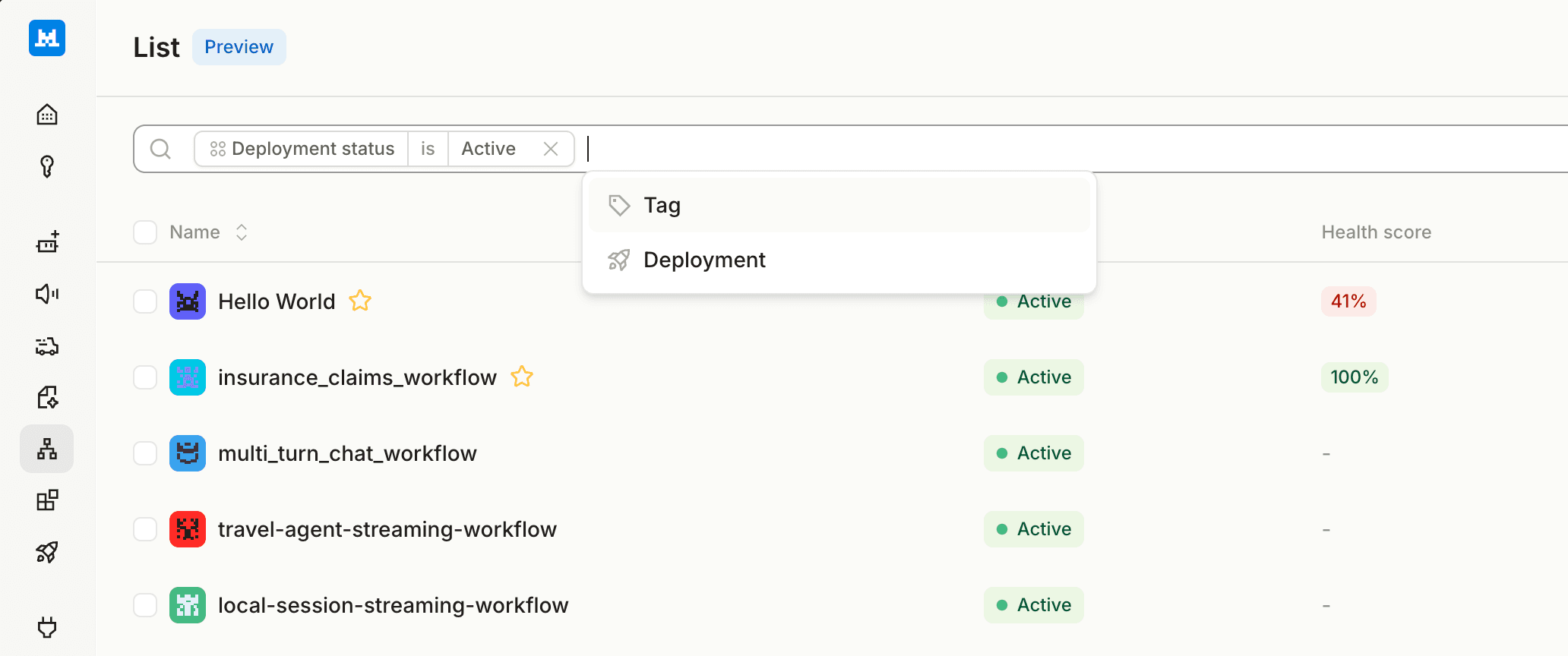
Navigating and monitoring workflows and their executions is now significantly easier with improved search, filtering, sorting, and pagination. This addresses customer pain points around discovering specific workflows and executions, analyzing run histories, and diagnosing failures by allowing precise filtering across major workflow properties and execution metrics.
Learn moreShow less
What's new
Navigating and monitoring workflows and their executions is now significantly easier with improved search, filtering, sorting, and pagination. This addresses customer pain points around discovering specific workflows and executions, analyzing run histories, and diagnosing failures by allowing precise filtering across major workflow properties and execution metrics.
Key capabilities
- Multi-status and property filtering: Filter workflows and executions by multiple statuses, name, ID, tags, deployment name, or the current user to quickly find relevant results.
- Favorite workflows: Star important workflows to easily access them later, bypassing the need to scroll through extensive workspace lists.
- Shareable filtered views: Search state is managed through URL parameters, allowing users to share specific, filtered views of workflows and executions with their team.
- Failure rate insights: View the failure rate per workflow and the health of recent runs to monitor success metrics and identify executions requiring retries.
- Enhanced search relevance and performance: Fuzzy search results are now sorted by relevance, and backend query performance has been optimized for a smoother list navigation experience.
- Execution search keys: Extract searchable key-value pairs from an execution's input, or attach them during the run, to make executions easily findable.
Get started
Explore the new filtering and sorting options directly in the Workflows and executions views. For more details, check the Studio documentation.