[2' read]
Mistral AI search engine
RAGSearch engine
Mistral AI search engine
!pip install aiohttp==3.9.5 beautifulsoup4==4.12.3 faiss_cpu==1.8.0 mistralai==0.4.0 nest_asyncio==1.6.0 numpy==1.26.4 pandas==2.2.2 python-dotenv==1.0.1 requests==2.32.3
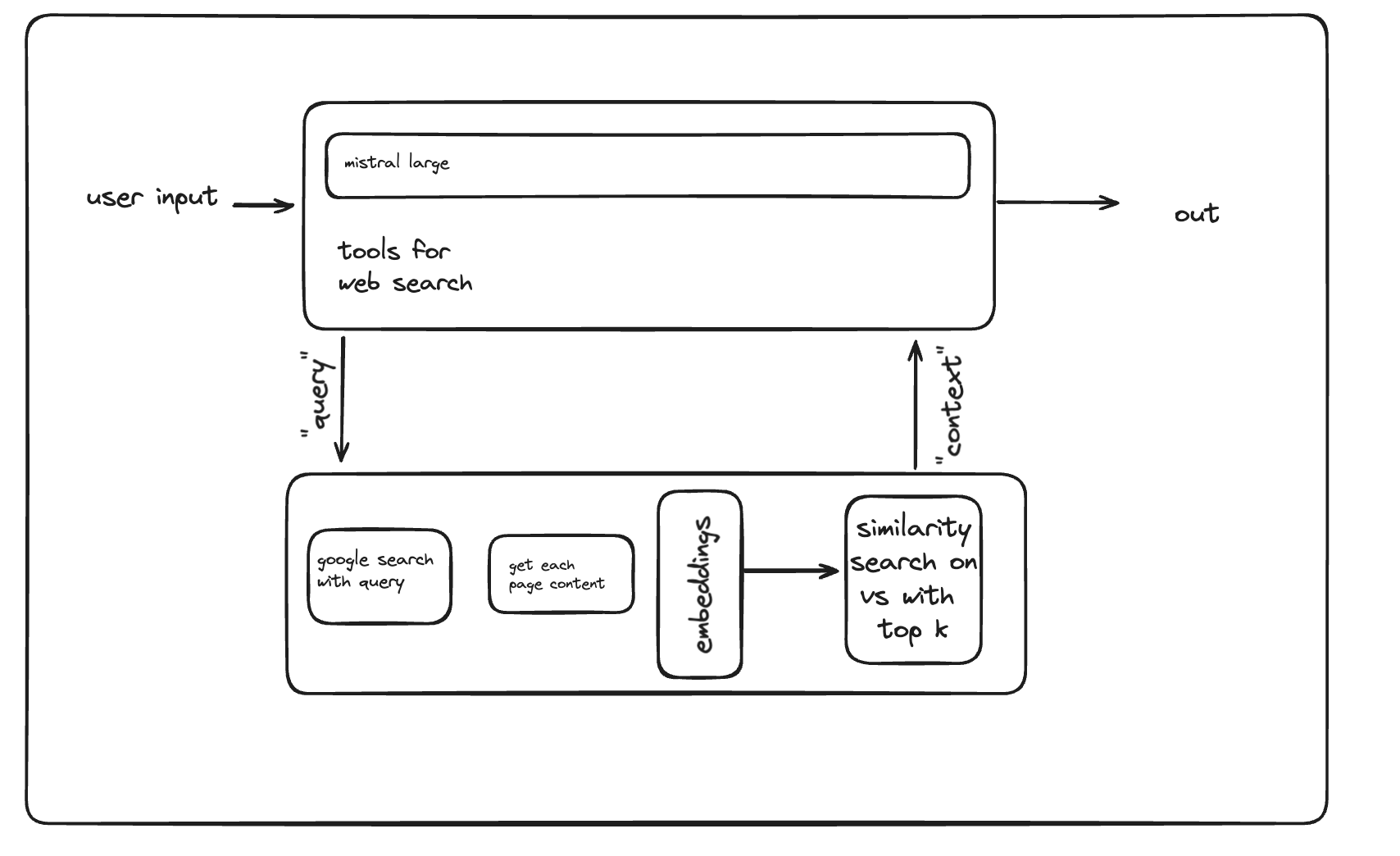
from dotenv import load_dotenv
import os

load_dotenv()  # load environment variables from .env file
MISTRAL_API_KEY = os.getenv("MISTRAL_API_KEY")Scraper Definitions
import aiohttp
import asyncio
import nest_asyncio
from bs4 import BeautifulSoup
from concurrent.futures import ThreadPoolExecutor
import requests
import re
import pandas as pd
import faiss
import numpy as np
from mistralai.client import MistralClient
from mistralai.models.chat_completion import ChatMessage

# Apply the nest_asyncio patch
nest_asyncio.apply()

headers = {
    "User-Agent": "Mozilla/5.0 (Windows NT 6.1; Win64; x64) AppleWebKit/537.36 (KHTML, like Gecko) Chrome/108.0.0.0 Safari/537.36"
}

total_results_to_fetch = 10  # total number of results to fetch
chunk_size = 1000  # size of each text chunk

dataframe_out_path = 'temp.csv'
faiss_index_path = 'faiss_index.index'

mistral_api_key = MISTRAL_API_KEY  # replace with your actual API key
client = MistralClient(api_key=mistral_api_key)

async def fetch(session, url, params=None):
    async with session.get(url, params=params, headers=headers, timeout=30) as response:
        return await response.text()

async def fetch_page(session, params, page_num, results):
    print(f"Fetching page: {page_num}")
    params["start"] = (page_num - 1) * params["num"]
    html = await fetch(session, "https://www.google.com/search", params)
    soup = BeautifulSoup(html, 'html.parser')

    for result in soup.select(".tF2Cxc"):
        if len(results) >= total_results_to_fetch:
            break
        title = result.select_one(".DKV0Md").text
        links = result.select_one(".yuRUbf a")["href"]

        results.append({
            "title": title,
            "links": links
        })

async def fetch_content(session, url):
    async with session.get(url, headers=headers, timeout=30) as response:
        return await response.text()

async def fetch_all_content(urls):
    async with aiohttp.ClientSession() as session:
        tasks = [fetch_content(session, url) for url in urls]
        return await asyncio.gather(*tasks)

def get_all_text_from_url(url):
    response = requests.get(url, headers=headers, timeout=30)
    soup = BeautifulSoup(response.text, 'html.parser')
    for script in soup(["script", "style"]):
        script.extract()
    text = soup.get_text()
    lines = (line.strip() for line in text.splitlines())
    chunks = (phrase.strip() for line in lines for phrase in line.split("  "))
    text = '\n'.join(chunk for chunk in chunks if chunk)
    return text

def split_text_into_chunks(text, chunk_size):
    sentences = re.split(r'(?<=[.!?]) +', text)
    chunks = []
    current_chunk = []

    for sentence in sentences:
        if sum(len(s) for s in current_chunk) + len(sentence) + 1 > chunk_size:
            chunks.append(' '.join(current_chunk))
            current_chunk = [sentence]
        else:
            current_chunk.append(sentence)

    if current_chunk:
        chunks.append(' '.join(current_chunk))

    return chunks

async def process_text_content(texts, chunk_size):
    loop = asyncio.get_event_loop()
    tasks = [loop.run_in_executor(None, split_text_into_chunks, text, chunk_size) for text in texts]
    return await asyncio.gather(*tasks)

async def get_embeddings_from_mistral(client, text_chunks):
    response = client.embeddings(model="mistral-embed", input=text_chunks)
    return [embedding.embedding for embedding in response.data]

async def fetch_and_process_data(search_query):
    params = {
        "q": search_query,  # query example
        "hl": "en",         # language
        "gl": "uk",         # country of the search, UK -> United Kingdom
        "start": 0,         # number page by default up to 0
        "num": 10           # parameter defines the maximum number of results to return per page.
    }

    async with aiohttp.ClientSession() as session:
        page_num = 0
        results = []
        while len(results) < total_results_to_fetch:
            page_num += 1
            await fetch_page(session, params, page_num, results)

        urls = [result['links'] for result in results]

        with ThreadPoolExecutor(max_workers=10) as executor:
            loop = asyncio.get_event_loop()
            texts = await asyncio.gather(
                *[loop.run_in_executor(executor, get_all_text_from_url, url) for url in urls]
            )

        chunks_list = await process_text_content(texts, chunk_size)

        embeddings_list = []
        for chunks in chunks_list:
            embeddings = await get_embeddings_from_mistral(client, chunks)
            embeddings_list.append(embeddings)

        data = []
        for i, result in enumerate(results):
            if i >= len(embeddings_list):
                print(f"Error: No embeddings returned for result {i}")
                continue
            for j, chunk in enumerate(chunks_list[i]):
                if j >= len(embeddings_list[i]):
                    print(f"Error: No embedding returned for chunk {j} of result {i}")
                    continue
                data.append({
                    'title': result['title'],
                    'url': result['links'],
                    'chunk': chunk,
                    'embedding': embeddings_list[i][j]
                })

        df = pd.DataFrame(data)
        df.to_csv(dataframe_out_path, index=False)

        # FAISS indexing
        dimension = len(embeddings_list[0][0])  # assuming all embeddings have the same dimension
        index = faiss.IndexFlatL2(dimension)

        embeddings = np.array([entry['embedding'] for entry in data], dtype=np.float32)
        index.add(embeddings)

        faiss.write_index(index, faiss_index_path)

await fetch_and_process_data("What is the latest news about apple and openai?")
little embeddings and vector store creation
def query_vector_store(query_embedding, k=5):
    """
    Query the FAISS vector store and return the text results along with metadata.

    :param query_embedding: The embedding to query with.
    :param k: Number of nearest neighbors to retrieve.
    :return: List of dictionaries containing text results and metadata of the k nearest neighbors.
    """
    # Load the index

    index = faiss.read_index(faiss_index_path)

    # Ensure the query embedding is a numpy array with the correct shape
    if not isinstance(query_embedding, np.ndarray):
        query_embedding = np.array(query_embedding, dtype=np.float32)
    if query_embedding.ndim == 1:
        query_embedding = np.expand_dims(query_embedding, axis=0)

    # Query the index
    distances, indices = index.search(query_embedding, k)

    # Load the dataframe
    df = pd.read_csv(dataframe_out_path)

    # Retrieve the text results and metadata
    results = []
    for idx in indices[0]:
        result = {
            'title': df.iloc[idx]['title'],
            'url': df.iloc[idx]['url'],
            'chunk': df.iloc[idx]['chunk']
        }
        results.append(result)

    return results

def query_embeddings(texts):
    """
    Convert text to embeddings using Mistral AI API.

    :param api_key: Your Mistral API key.
    :param texts: List of texts to convert to embeddings.
    :return: List of embeddings.
    """
    client = MistralClient(api_key=MISTRAL_API_KEY)
    response = client.embeddings(model="mistral-embed", input=[texts])
    return [embedding.embedding for embedding in response.data]


embeddings = query_embeddings("AGI")
results = query_vector_store(embeddings[0], k=5)
results
tools definition
nest_asyncio.apply()

tools = [
    {
        "type": "function",
        "function": {
            "name": "mistral_web_search",
            "description": "Fetch and process data from Google search based on a query, store results in FAISS vector store, and retrieve results.",
            "parameters": {
                "type": "object",
                "properties": {
                    "search_query": {
                        "type": "string",
                        "description": "The search query to use for fetching data from Google search."
                    }
                },
                "required": ["search_query"]
            },
        },
    },
]


def mistral_web_search(search_query: str):
    async def run_search():
        await fetch_and_process_data(search_query)
        embeddings = query_embeddings(search_query)
        results_ = query_vector_store(embeddings[0], k=5)
        return results_

    return asyncio.run(run_search())

search_query = "mistral and openai"
results = mistral_web_search(search_query)
print(results)
""" little helper function to extract only the texts """
def tools_to_str(tools_output: list) -> str:
    return '\n'.join([tool['chunk'] for tool in tools_output])


tools_to_str(mistral_web_search(search_query))import functools
names_to_functions = {
'mistral_web_search': functools.partial(mistral_web_search),
}chat
messages = [
    ChatMessage(role="user", content="What happend during apple WWDC 2024?"),
]
model = "mistral-large-latest"

client = MistralClient(api_key=MISTRAL_API_KEY)
response = client.chat(model=model, messages=messages, tools=tools, tool_choice="any")
responsemessages.append(response.choices[0].message)import json
tool_call = response.choices[0].message.tool_calls[0]
function_name = tool_call.function.name
function_params = json.loads(tool_call.function.arguments)
print("\nfunction_name: ", function_name, "\nfunction_params: ", function_params)function_result = tools_to_str(names_to_functions[function_name](**function_params))
function_resultmessages.append(ChatMessage(role="tool", name=function_name, content=function_result, tool_call_id=tool_call.id))
response = client.chat(model=model, messages=messages)
response.choices[0].message.content
Chat in a chain (cleaner user experience)
messages = []

while True:
    input_ = input("Ask: ")
    messages.append(ChatMessage(role="user", content=input_))
    response = client.chat(model=model, messages=messages, tools=tools, tool_choice="any")
    messages.append(response.choices[0].message)
    print(response.choices[0].message.content)
    tool_call = response.choices[0].message.tool_calls[0]
    function_name = tool_call.function.name
    function_params = json.loads(tool_call.function.arguments)

    function_result_raw = names_to_functions[function_name](**function_params)
    print("sources: ", [f"{source['title']} - {source['url']}" for source in function_result_raw])
    function_result_text = tools_to_str(function_result_raw)
    messages.append(ChatMessage(role="tool", name=function_name, content=function_result_text, tool_call_id=tool_call.id))

    response = client.chat(model=model, messages=messages)
    final_response = response.choices[0].message.content
    print(final_response)